Elite ElectricianElite Electrician

Whole-Home Surge Protection Systems los angeles

A whole-home surge protector fits residences running sensitive electronic loads, variable-speed HVAC compressors, heat pump water heaters, and Level 2 EV charging stations. Point-of-use power strips merely absorb…
Get My Free Estimate →(840) 220-2859
Whole-Home Surge Protection Systems in los angeles, CA
Quick answer
  • What is included: Installation of a dual-pole 240V Type 1 or Type 2 surge protective device (SPD) directly inside or adjacent to the primary electrical service panel, including dedicated breaker integration and grounding electrode verification.
  • Turnaround time: Typical panel installation takes between 60 and 90 minutes; same-day dispatch is scheduled subject to panel access and service equipment compatibility.
  • Base cost: Standard installation ballparks between $450 and $1,250 depending on panel configuration, busbar clearance, and device kA rating; all service visits require a minimum charge of $200.
  • Hardware handled: We integrate commercial-grade 50kA to 100kA metal oxide varistor (MOV) arrestors compliant with UL 1449 4th Edition standards, compatible with Square D, Siemens, Eaton, and Leviton panels.
  • How to schedule: Confirm the main electrical panel brand and amperage, photograph the panel exterior and interior labeling, and call (840) 220-2859 to establish an arrival window.

A whole-home surge protector fits residences running sensitive electronic loads, variable-speed HVAC compressors, heat pump water heaters, and Level 2 EV charging stations. Point-of-use power strips merely absorb localized downstream spikes up to a limited joule rating; in contrast, a panel-mounted surge protective device (SPD) arrests transient voltages up to 100,000 amps directly at the service entrance. The trade-off involves breaker space: installing a Type 2 unit requires two open vertical breaker spaces in the existing panel. When an older 100-amp split-bus panel in Los Feliz, Echo Park, or Silver Lake lacks physical slots or contains obsolete Zinsco or Federal Pacific equipment, resolving space limitations requires either a tandem-breaker consolidation, a dedicated external enclosure, or a full 200-amp service upgrade.

Transient spikes in Los Angeles County originate from two distinct sources: external grid events from the Los Angeles Department of Water and Power (LADWP) or Southern California Edison (SCE) distribution switching, and internal inductive loads cycling on and off. In hillside neighborhoods like Studio City and Sherman Oaks, high ambient temperatures trigger continuous cycling of large 4-ton and 5-ton central air compressors, generating internal micro-surges that degrade control boards over time. Near coastal zones such as Venice and Mar Vista, salt-air exposure accelerates oxidation on grounding electrode conductors, increasing ground resistance and diminishing the discharge speed of transient voltage suppression devices. Ground path resistance must be measured to verify the home's grounding system stays below the 25-ohm threshold mandated by electrical code.

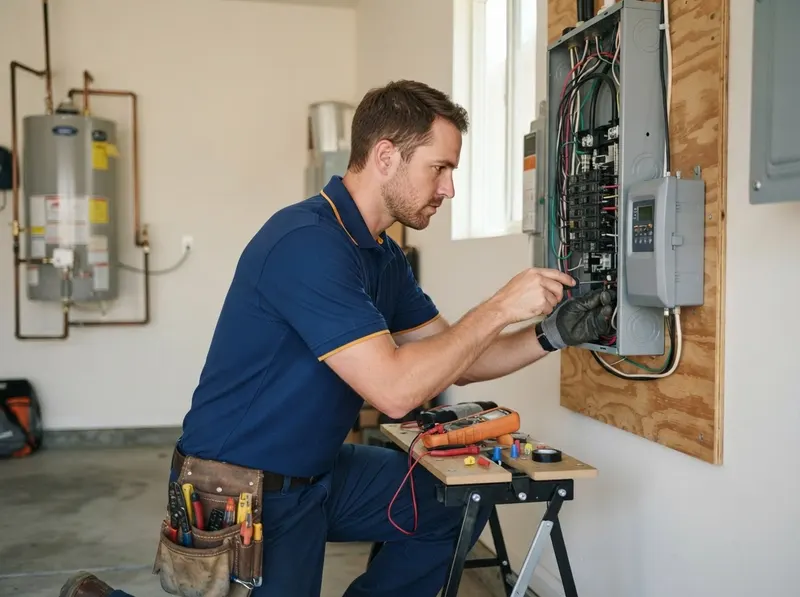
Installing panel-level protection involves precise mechanical and electrical steps. 1. De-energize the main disconnect to test voltage absence across all panel terminals using a calibrated multimeter. 2. Mount the surge device adjacent to the main breaker to keep conductor leads shorter than 12 inches, minimizing line inductance. 3. Connect the surge device leads to a dedicated 20-amp or 30-amp two-pole circuit breaker while routing neutral and equipment grounding conductors to their respective busbars. 4. Re-energize the service and inspect the illuminated status-indicator LEDs to verify phase-to-neutral and phase-to-ground clamp pathways. In classic Craftsman and Spanish Colonial properties throughout Highland Park, Westwood, and Boyle Heights, ungrounded two-wire branch systems limit surge paths; installing a code-compliant grounding electrode system with dual ground rods spaced at least 6 feet apart is required for the surge unit to divert transients.

Whole-Home Surge Protection Systems cost in los angeles

Standard Diagnostic & On-Site Evaluation (Base Minimum)$200
Type 2 Panel-Mounted SPD Installation (50kA, Existing Breaker Space)$450 - $650
Heavy-Duty Type 1/2 SPD Installation (80kA - 100kA, Smart Diagnostic LEDs)$650 - $950
External Enclosure SPD Addition (Full Panel / No Spare Breaker Slots)$850 - $1,250
Grounding Electrode System Modernization (Dual Ground Rods & Bonding)$600 - $1,100

Every job gets a firm, written price after a free on-site visit.

Common questions

What is the difference between Type 1 and Type 2 surge protectors in los angeles?
Type 1 surge devices are installed on the line side of the main service disconnect between the utility meter and panel, protecting against external utility grid switching; Type 2 devices mount on the load side directly to an interior branch breaker to intercept both external transients and internal motor spikes. Los Angeles single-family residences commonly utilize Type 2 units inside the primary service cabinet, while homes with exterior meter-main combination boxes often utilize Type 1 units to stop surges before entering interior subpanels.
How does a surge suppressor handle Los Angeles electrical grid fluctuations?
A surge suppressor handles utility grid fluctuations by using metal oxide varistors that transition from high resistance to low resistance in less than one nanosecond when voltage rises above 120 volts to ground, shunting the excess amperage safely into the grounding system. LADWP and SCE infrastructure can produce voltage spikes during regional switching operations, and an SPD clamps these spikes down to safe voltage protection ratings (VPRs) between 600 and 700 volts.
Can whole-home surge protection be installed on older 100-amp panels in los angeles?
Yes, whole-home surge protection can be installed on older 100-amp panels if two open breaker slots are available or if space is recovered using approved tandem breakers. If an older panel located in neighborhoods like Highland Park or Silver Lake utilizes hazardous split-bus architecture or obsolete busbars without compatible UL-listed breakers, the installation requires an externally mounted SPD connected through a rigid conduit nipple.
Does a whole-home surge unit protect electric car chargers in los angeles?
A whole-home surge unit protects 240-volt Level 2 electric vehicle charging hardware from upstream grid spikes, but it does not replace the dedicated overcurrent breaker required for the EV circuit. Installing an 80kA to 100kA panel-level SPD mitigates line-to-line and line-to-ground transients before they reach the onboard inverter and computerized battery management system of vehicles charging in Los Angeles garages.
What permits are required for panel surge suppressor installations in los angeles?
Adding a surge protective device directly to an existing electrical panel typically falls under a standard LADBS electrical repair permit when conducted as part of panel servicing or service additions. An on-site electrical inspection verifies that the conductor lengths remain under code limits, that overcurrent protection matches manufacturer specifications, and that the grounding electrode conductor meets Los Angeles municipal code requirements.
Helpful resources

Trusted references & local links

USA.gov, government & consumer helpBetter Business BureauFTC Consumer AdviceU.S. Small Business AdministrationReady.govU.S. Dept. of EnergyENERGY STARHUD, homeownershipOSHA, safety standardsU.S. Green Building CouncilGoogle Maps, los angeles, CA

Get started today

Tell us about your whole-home surge protection systems job in los angeles and we'll send a clear, written quote, usually the same day.

Get your free Electrician quote, los angeles

We only use your ZIP to check availability, no spam.