Modernizing legacy protection systems requires precise architectural isolation because older residential structures throughout Los Angeles County often conceal multi-wire branch circuits sharing a single neutral…
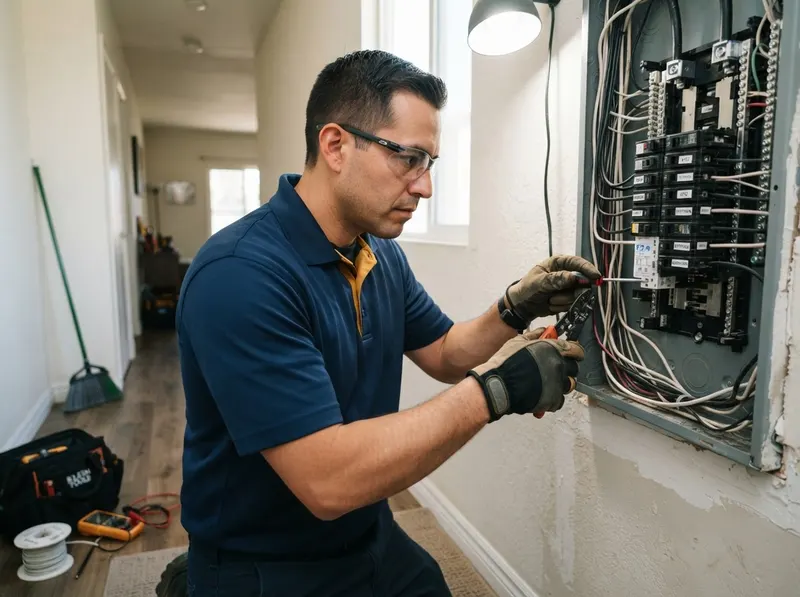
Modernizing legacy protection systems requires precise architectural isolation because older residential structures throughout Los Angeles County often conceal multi-wire branch circuits sharing a single neutral conductor. In 1920s Craftsman homes in Highland Park or mid-century structures across Studio City, retrofitting an arc fault circuit interrupter directly onto an unseparated neutral causes instant microsecond trips as return currents split across different phases. Standard thermal-magnetic breakers ignore parallel arcing behind lath-and-plaster walls until conductors reach 1,000 degrees Fahrenheit, whereas modernized AFCI devices sample electrical waveforms via onboard microprocessors to detect intermittent micro-arcs down to 5 amperes. Similarly, standard grounded three-prong outlets installed on legacy two-wire knob-and-tube runs in Silver Lake or Echo Park present shock liabilities unless protected upstream by class-A GFCI devices calibrated to trip within 25 milliseconds when leakage current exceeds 4 to 6 milliamperes.
Selecting whole-panel dual-function breakers over point-of-use receptacles depends on circuit continuity, physical box capacity, and local permitting thresholds enforced by the Los Angeles Department of Building and Safety (LADBS). For finished living areas such as bedrooms, living rooms, and dens in Sherman Oaks or Westwood, installing combination AFCI/GFCI breakers directly inside the distribution panel provides complete wiring protection from the busbar through the entire conduit run without requiring wall penetrations. Conversely, where conduit fill ratios or inaccessible junction boxes prevent home-run rewiring, installing dedicated point-of-use feed-through GFCI receptacles at the first branch outlet protects downstream loads while keeping plaster finishes intact. In coastal salt-air corridors like Venice and Mar Vista, outdoor condensing units, garage subpanels, and pool circuits require corrosion-resistant, weather-rated Class-A ground fault protection to stop ambient moisture from triggering nuisance faults.
The installation protocol follows clear structural stages: 1. Disconnect the main service line and perform continuity tests on individual neutral legs using digital multimeters to map shared neutral paths. 2. Remove outdated standard single-pole breakers and evaluate busbar stabs for mechanical pitting or thermal discoloration. 3. Terminate dedicated circuit neutrals onto corresponding AFCI/GFCI breaker pigtails or plug-on neutral bus rails to isolate ground-return loops. 4. Energize each modernized branch circuit, applying load testing instruments that simulate true line-to-neutral series arcs and 6-milliamp ground leakage faults to confirm millisecond trip compliance without disturbing interior drywall. Homeowners booking diagnostics can mention this overview to receive $25 off a same-day pickup or inspection.
Every job gets a firm, written price after a free on-site visit.
Tell us about your arc fault & ground fault circuit interrupter modernization job in los angeles and we'll send a clear, written quote, usually the same day.
 Elite Electrician